Release incoming pulp
Supplier specification, package and delivery criteria.
View details ↗Processing lines
Start after extraction and select receiving, screening, blending and transfer only where the supplied pulp needs them.
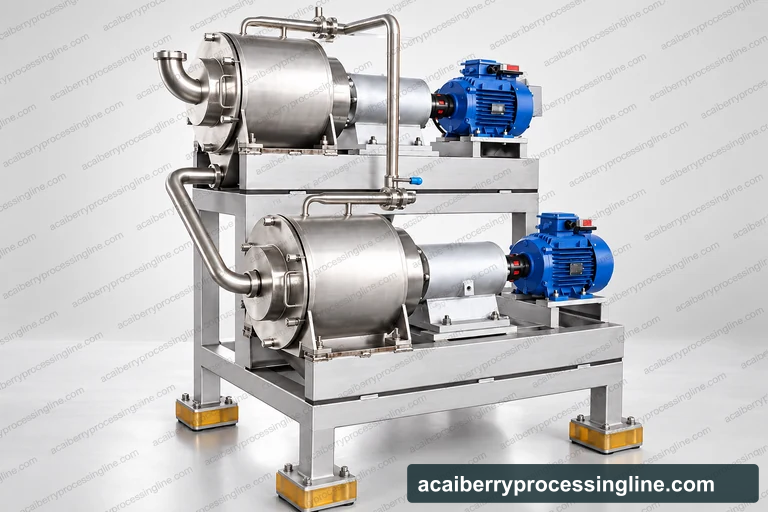
Purchased pulp can remove the whole-fruit front end from the project. It does not remove the need for a defined receiving, hygiene and preservation plan. Begin with the supplier product and package, compare them with the intended output, then select the operations needed to bridge the difference. Each finishing module should have a clear purpose.
Connected process
Supplier specification, package and delivery criteria.
View details ↗Controlled handling when blocks or other preparation are involved.
View details ↗A defined coarse-material or texture duty.
View details ↗Declared recipe and measurable uniformity.
View details ↗A defined preservation and receiving route.
View details ↗Record the supplier specification, declared ingredients, total-solids method, texture and treatment history. Define the final product using the same measurement basis where possible. This exposes whether the project needs preparation, screening, formulation or simply controlled transfer and packing.
Use purchased-pulp input as the capacity basis, with final output separately stated. Whole-fruit input and seed yield do not apply to this inlet. If the plant also receives berries, show it as a separate route and identify any shared finishing equipment.
Frozen, chilled and aseptic pulp require different receiving descriptions. Provide incoming pack dimensions, unit mass, opening or connection method and delivery condition. Map external packaging removal and waste collection before selecting the receiver.
For frozen blocks, use a controlled preparation plan to reach the downstream inlet condition. For aseptic supply, decide whether a sterile connection is maintained or whether opening starts a new finishing and preservation boundary. The supplied package label does not define the later process.
Screening removes material retained by the chosen screen. Evaluate the accepted texture and retained stream before adding it. Blending changes the recipe or uniformity and needs a declared mass basis, addition method and measurable product result.
A buffer can reconcile timing between these operations and packing, but it creates product inventory. Size usable hold-up from the schedule and permitted holding condition. Transfer equipment must be selected for the actual product and full circuit.
| Module | Include when |
|---|---|
| Controlled receiving | Needed to release and handle the supplied pulp |
| Screen / refiner | A defined physical finish or retained-material requirement remains |
| Blending | A declared formulation or standardization duty exists |
| Buffer / transfer | The operating schedule and product circuit require it |
| Treatment / filling | Required by the final product and selected preservation route |
The final pulp can enter frozen packing, a validated aseptic route or a customer ingredient handover. The required treatment and preservation are determined for the actual final product and process. Opening and reformulating supplied pulp can change that basis.
Where the project is mainly transferring bulk pulp into smaller packs, show repacking directly. Keep package opening, hygienic handling, filling, closure, traceability and the renewed preservation assessment visible rather than adding unnecessary extraction equipment.
A useful enquiry includes supplier pulp information, incoming package, target finish, quantity basis, output package and equipment already available. A line sketch can identify receiving, transfer and cleaning boundaries even before final model selection.
No fixed plant price, generic pulp output or universal holding condition is verified here. Ask the proposal to list conditional modules and the evidence needed to confirm them. This makes each item reviewable against a product requirement and an operating duty.
Those duties belong to whole fruit. A pulp-only project begins with receiving and any preparation required by the supplied format.
Only for a defined requirement after comparing the incoming pulp with the target product. Re-screening is not an automatic preservation or quality improvement.
Do not assume it. Opening, handling, formulation and the new package alter the process boundary and require the product owner to establish the appropriate evidence.
Share your incoming material, production target and package format. The right configuration starts with a clear product brief.
Request a Quote ↗Equipment selection
Share your raw material, pulp target and packaging requirements.