Specify the prepared berry
State fresh or frozen supply, preparation already completed and the condition the pulper will actually receive. Whole frozen berries retain their seeds and require their own hygienic preparation plan. Record lot variation that may affect feeding and separation.
Confirm the feed arrangement, controls over surges and any permitted process-water addition. Water entering extraction belongs in the mass balance. It should not disappear inside a reported pulp-output number or be confused with wash-water use.
Assess pulp recovery and the seed outlet together
Inspect discharged seeds for residual edible material and damage, while assessing the product for fragments and coarse material. Increasing extraction intensity may change both streams. A trial should expose those tradeoffs rather than reporting accepted-pulp mass alone.
Provide accessible collection and sampling at each outlet. Agree when the system has reached stable conditions and whether start-up, retained product and shutdown losses are included in the acceptance interval. Weigh feed, water, pulp and rejects over the same period.
Give each extraction stage a job
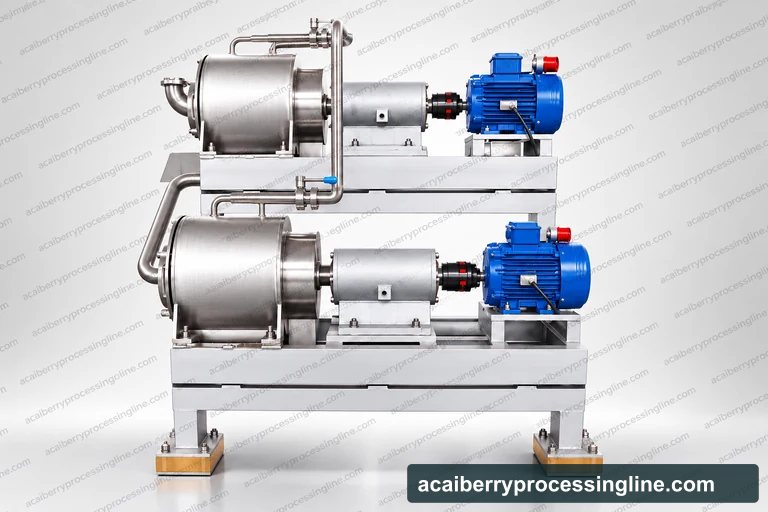
A single-stage arrangement may perform the required seed separation; a second stage may add a distinct finishing duty. The correct choice follows the required pulp texture and the observations from representative trials. Two cylinders do not establish a better result by themselves.
Ask the proposal to identify the feed mechanism, separation surfaces, rotor arrangement, screen access and seed discharge. Screens and working settings must be assessed for açaí. General fruit-pulping catalog equipment is evidence of a configuration family, not an açaí-specific performance guarantee.
| Observe | Record alongside it |
|---|---|
| Accepted pulp | Mass, sampling interval, texture and analytical solids method |
| Seed discharge | Mass, residual pulp and observed seed damage |
| Process water | Measured addition and where it enters |
| Stable operation | Feed continuity, screen loading, interruptions and retained product |
Review wear and cleaning before purchase
Request the method for opening the separator, removing screens, checking wear surfaces and restoring the assembly. Include a safe maintenance envelope in the layout, with access to guards, drives and the full withdrawal distance for removable parts.
Establish which components are cleaned manually and which circuits can be cleaned in place. A product inlet and a cleaning connection do not prove that seed outlets, screens, seals or hidden recesses are fully covered. Cleaning verification belongs in the agreed operating procedure.
Turn the trial into a purchase requirement
A configured acceptance schedule should name the representative fruit, preparation, water basis, target finish, measured streams and inspection method. Keep accepted pulp output separate from whole-fruit feed and final formulated or packed output.
No numeric throughput, yield, screen aperture or installed-power claim is made here. Those values require the selected model and product evidence. Bring the trial result into the full-line balance so the refiner, tank and downstream packing are selected for what extraction actually delivers.
Preserve the trial information for production
Keep a trial record that links the fruit lot, preparation, screen identification and working settings to labelled product and seed samples. Record where material was collected and how residual product was accounted for. The result should be interpretable after the demonstration ends, so it can support model selection, operator training and later investigation when a different fruit lot changes the separation behaviour or finished texture.
Configuration & selection basis
| Inlet | Prepared whole berries; measured process water where required |
|---|---|
| Outlet | Pulp stream and a separate seed / coarse-reject stream |
| Selection evidence | Actual-fruit trial with stream measurements |
| Model ratings | To be confirmed in the configured proposal |
The proposal defines model-specific ratings after product review and trials. Catalog performance with other fruits is not a validated açaí capacity.
Questions from equipment buyers
Can a standard crusher replace an açaí pulper?
A crusher specification does not establish controlled açaí seed separation. Require evidence with the intended berries, including seed integrity and the resulting pulp.
Is a two-stage pulper necessary?
It depends on the required finish and the work assigned to each stage. Compare the actual streams, texture, cleaning and retained product before selecting another stage.
What does an extraction yield mean?
It needs a stated mass basis. Identify fruit, added water, accepted pulp and rejects over the same interval, with the product solids specification and analytical method.
Technical references
Let’s define your equipment.
Share your incoming material, production target and package format. The right configuration starts with a clear product brief.
Request a Quote ↗