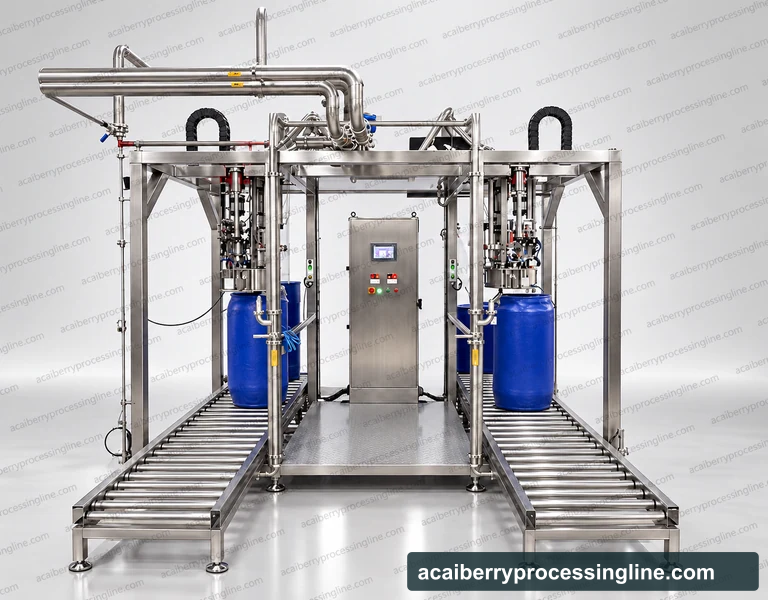
Draw the sterile pathway
Mark the product outlet of the treatment system, any aseptic holding vessel, transfer pipework, filler and package closure. Identify valves, instruments and connections along that pathway. Every included component needs a defined cleaning and sterilization duty and a responsible validation owner.
An existing upstream system should be described with its permitted product conditions, flow range and connection details. Do not assume compatibility because two catalog machines both use the word aseptic. Their operating states, pressure conditions and stop / restart sequences must be coordinated.
Use the exact package specification
Provide bag supplier, format, fitment drawing, closure arrangement and intended supporting container. State target fill mass and how the bag is presented, loaded and removed. Nominal bag volume does not establish head compatibility.
Ask the filler and packaging suppliers to confirm the precise combination in writing. Include the package preparation and closure method, handling of the fitment and the means of identifying package lots. A fitment substitution should enter the change-control and validation review rather than being treated as a minor purchasing change.
Calculate output from the complete cycle
Separate product flow while filling from completed packages per operating period. Loading, connection, fill completion, closure, removal and changeover can affect the line. Compare the proposed sequence with the bag size, supporting container and available operator handling arrangement.
The upstream process must have an engineered response to filler pauses. Define readiness signals, stop requests and the destination of product that cannot continue to the package. Establish product recovery and disposition without compromising the sterile boundary.
| Interface | Required evidence |
|---|---|
| Product | Specified pulp, temperature / pressure conditions and upstream process |
| Package | Bag and fitment drawings, supplier and confirmed compatibility |
| Cycle | Fill mass plus loading, closure and changeover sequence |
| Services | Configured cleaning / sterilization and operating utility conditions |
| Acceptance | Equipment checks, package integrity and validation responsibilities |
Define services in each operating state
Request utility conditions separately for production, cleaning, sterilization, standby and restart. Service availability during package changes can be as relevant as peak production demand. Identify supply quality and drainage or return connections from the actual selected configuration.
Review loss-of-service actions and the information recorded by the control system. Decide how the operator recognizes a state that prevents filling and who releases the system after corrective action. These requirements should appear in the functional description and training material.
Agree package and system acceptance
Inspect filled packages using a defined package-integrity method and the packaging supplier requirements. Equipment checks also cover instrumentation, interlocks, records and the agreed filling sequence. Keep factory demonstration, installed-system verification and product-process validation as distinct evidence items.
The manufacturer catalog confirms an aseptic bag-filling equipment family. It does not verify the chosen fitment, açaí output, storage life or utility demand for this project. Request model-specific drawings and compatibility evidence before freezing the package and machine purchase.
Rehearse a package change and restart
Review a complete package change with the actual bag and supporting container. Identify what the operator touches, which states the control system requires and how the upstream process responds during the pause. Repeat the discussion for an interrupted fill and a rejected package. This establishes the questions that the configured supplier procedure and validation plan must answer before a nominal filling flow is accepted as usable production capacity.
Configuration & selection basis
| Inlet | Product from a validated upstream aseptic process |
|---|---|
| Outlet | Closed bulk packages meeting the agreed validation criteria |
| Package basis | Exact bag, fitment, support and target fill mass |
| Output basis | Complete package cycle at stated product conditions |
| Acceptance | System operating sequence and package integrity |
The proposal defines model-specific ratings after product review and trials. Catalog performance with other fruits is not a validated açaí capacity.
Questions from equipment buyers
Can an aseptic filler accept untreated pulp?
An aseptic bag filler alone does not make untreated pulp safe or shelf stable. It needs an appropriate upstream process and a maintained sterile product pathway.
Are all bags of the same volume compatible?
No. Fitment dimensions, closure, package preparation and the filling head must be checked for the exact supplier combination.
Is the advertised fill rate the packed output of the line?
Completed output also depends on product flow, fill mass, package handling, closure and changeovers. Specify the full operating cycle.
Technical references
Let’s define your equipment.
Share your incoming material, production target and package format. The right configuration starts with a clear product brief.
Request a Quote ↗