Receive pulp
Release the supplied specification and package.
View details ↗Processing lines
Configure pulp receiving, finishing, batch formulation and a defined handover to the beverage processor.
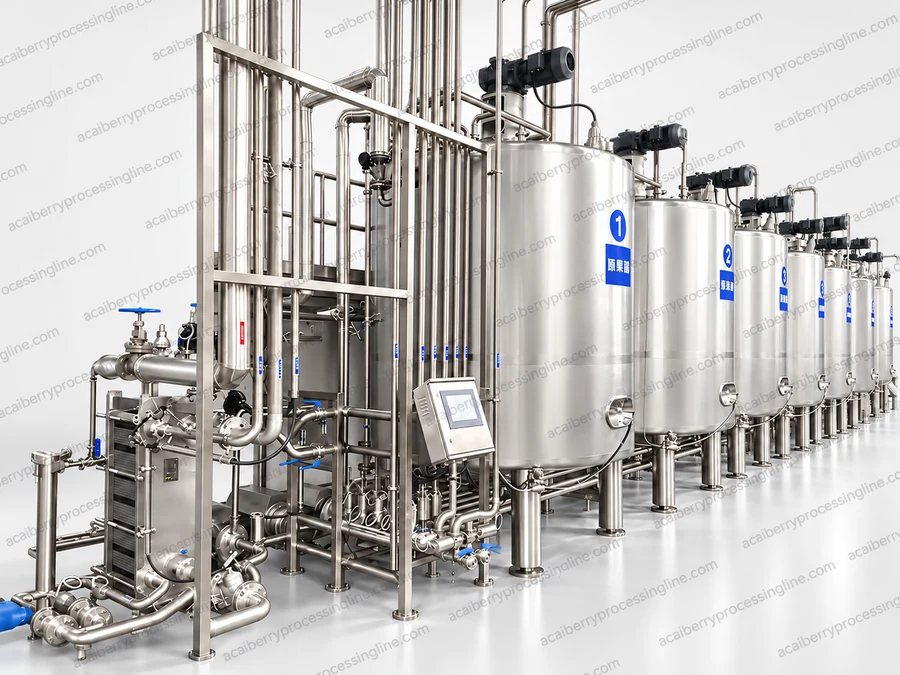
A beverage base is a specified ingredient delivered to the next stage of beverage manufacture. It may be plain pulp, a standardized pulp blend or a formulated intermediate. Define that product and the customer receiving conditions before selecting mixing equipment or assuming where final treatment and retail filling occur.
Connected process
Release the supplied specification and package.
View details ↗Screen only for a defined product requirement.
View details ↗Control recipe, additions and uniformity.
View details ↗Assign the actual preservation responsibility.
View details ↗Confirm container, condition and acceptance.
View details ↗Describe the intended ingredient, declared additions, target texture and analytical specification. Keep total solids distinct from soluble-solids readings. The customer specification should identify its sampling and receiving method so the plant can evaluate the product on a comparable basis.
Confirm whether final dilution, homogenization, treatment and retail filling occur in this project or at the beverage customer. The phrase beverage base does not answer those questions. Put the delivery point and remaining operations on the scope drawing.
Whole berries add reception, washing, preparation and seed separation before ingredient production. Purchased pulp starts after extraction, with supplier release and pack handling. Select the inlet from the supply plan rather than adding both front ends by default.
For prepared pulp, compare the supplied texture and formulation with the final base. A refiner should have a defined removal duty. Any preparation of frozen blocks needs a controlled method that delivers the condition required by transfer and blending.
Specify target batch mass, permitted ingredient ranges and addition order. Describe powders, syrups and other ingredients by their handling properties. Define the minimum and maximum working batch and the product consistency at process temperature.
Select mixing for an agreed uniformity or dispersion result. Include charging, mixing, sampling, release, emptying and cleaning in the cycle balance. A motor rating or mixing-only time is not a measure of finished beverage-base output.
| Decision | Record |
|---|---|
| Product | Plain pulp, standardized blend or formulated intermediate |
| Recipe | Mass basis, declared additions and sampling method |
| Mixing | Batch range, addition sequence and uniformity requirement |
| Preservation | Treatment / packing responsibility for the final base |
| Delivery | Customer container, temperature, specification and schedule |
A formulation change can alter product behaviour and the process design basis. The product and food-safety specialists must evaluate the final blend and its route. Do not carry the supplier pulp treatment or storage statement into a new formulation without review.
If the base is packed frozen, define the freezer handover. If it is bulk aseptic, specify the complete treatment, sterile transfer and package system. If it is transferred to a nearby processor, document the accepted receiving condition and product responsibility at that connection.
Send the incoming pulp specification, physical ingredient properties, target batch range and customer receiving requirements. Identify retained tanks, transfer distance, available services and changeover needs. A product category and measured range can support initial selection without revealing a complete confidential recipe.
The configured proposal should state product assumptions, equipment duties and acceptance methods. No stock recipe, mixing time, treatment setting or model output is verified here. A clear customer handover lets the proposal cover the operations that actually belong to this project.
Only when expressly included. Many projects deliver an ingredient to another processor. The final treatment and filling responsibility must be stated.
Yes, as an inlet configuration when its supplier specification and handling are suitable. The receiving, finishing and formulation duties follow the intended base.
Confirm the working range, product consistency, addition method, required uniformity and cleaning duty for each product family.
Share your incoming material, production target and package format. The right configuration starts with a clear product brief.
Request a Quote ↗Equipment selection
Share your raw material, pulp target and packaging requirements.